
Knowing how to count pips, points, and ticks: and how to convert them into an exact lot size: prevents the single most common beginner disaster in multi-asset trading: entering 1.00 lot on Gold or NAS100 thinking it carries the same dollar risk as 1.00 lot on EUR/USD. By the end of this lesson, you will be able to read the price quote of any Forex pair, Stock Index, Commodity, or Cryptocurrency on 4CM-AI Charts and calculate your exact position size in under 10 seconds so every trade risks the exact same dollar amount.
Everyday analogy: why "1.00 Lot" is like saying "1 Box": Imagine ordering "1 box" from a wholesale warehouse. One box of bottled water costs $10, one box of smartphones costs $10000, and one box of gold bars costs $265000. In trading platforms, the word Lot simply means "one standardized contract box." Before you type 1.00, 0.10, or 0.01 into your order ticket, you must know how many units sit inside that symbol's box and how much money each price step is worth.
Step 1: How to read any price quote (Base vs. Quote)
Every symbol you see on 4CM-AI Charts is written as a pair of two codes: the Base asset (first code) and the Quote currency (second code):
- The Base asset (left side) is WHAT you are buying or selling: It always represents 1 unit of the item: for example,
1euro inEUR/USD,1troy ounce of gold inXAU/USD, or1Bitcoin inBTC/USD. - The Quote currency (right side) is the PRICE TAG: It tells you how much of the second currency you must pay to buy
1unit of the first asset.
Let's trace three real examples side by side:
- When
EUR/USD = 1.0850, 1 Euro (Base) costs $1.0850 US Dollars (Quote). If you think the Euro will strengthen against the Dollar, you click Buy; if the rate rises from1.0850to1.0950, the Euro gained$0.0100(100pips) per Euro. - When
XAU/USD = 2650.00, 1 Troy Ounce of Gold (Base, chemical symbolXAU) costs $2650.00 US Dollars (Quote). - When
USD/JPY = 152.40, 1 US Dollar (Base) costs 152.40 Japanese Yen (Quote). Notice that here the US Dollar is on the left. If the US Dollar strengthens against the Yen,USD/JPYgoes up; if the Yen strengthens,USD/JPYgoes down.
Step 2: Pip, Point, and Tick across the 4 markets
Because a currency exchange rate like 1.0850 looks completely different from a Gold price like $2650.00 or a Nasdaq index level like 20450.0, each market uses its own yardstick to measure price change. Look at the four panels in the diagram below to see exactly which digit you count in each market:
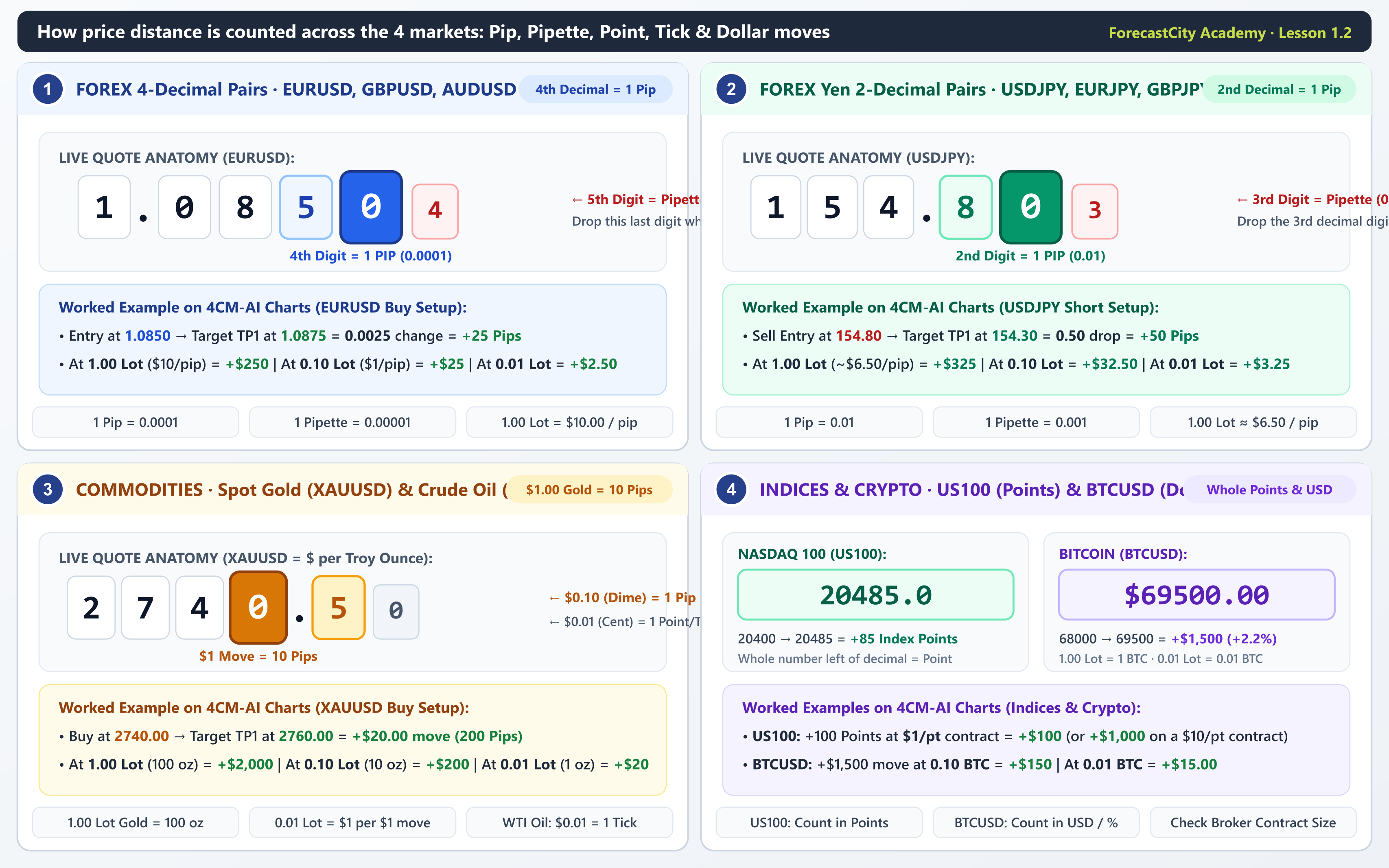
- Standard Forex Pairs (5-Digit Quotes like EUR/USD = 1.08542): The 4th decimal place (the
4in1.08542, equal to0.0001) is 1 Pip, which is the universal unit traders use to measure Forex stops and targets. The smaller 5th decimal place (the2, equal to0.00001) is 1 Point (Pipette), or one-tenth of a pip (10 Points = 1 Pip). - Japanese Yen Pairs (3-Digit Quotes like USD/JPY = 152.456): Because a single Japanese Yen is worth roughly one US cent, Yen pairs have only two main decimal places. Here, the 2nd decimal place (the
5in152.456, equal to0.01) is 1 Pip, while the 3rd decimal place (0.001) is 1 Point (Pipette). - Commodities: Gold (XAU/USD) and Crude Oil (WTI / BRENT): Professional commodity traders skip confusing "pip" slang and measure moves directly in Dollars and Cents. If Gold climbs from
$2650.00to$2665.00, that is a $15.00 move per ounce (equal to1500ticks of$0.01). If Crude Oil rises from$71.20to$72.70, that is a $1.50 move per barrel. - Stock Indices (NAS100, US500, GER40) and Crypto (BTC/USD): Indices and Bitcoin are measured in whole Index Points or Dollars to the left of the decimal point. When
NAS100rallies from20400.0to20520.0, it moved 120 Index Points. WhenBTC/USDclimbs from$68000to$69500, it moved $1500.
Watch out for the "Pip vs. Point" trap in MetaTrader / cTrader: Many trading terminals label the 5th decimal place (0.00001) as a "Point." If you want a 25-pip stop loss on EUR/USD, that equals 250 terminal points (0.00250). Always verify the actual price level on your 4CM-AI Charts rather than guessing raw point numbers.
Step 3: Lot size and contract value explained
Now that you can measure how far price moved, how do you know how many dollars you make or lose on that move? That depends entirely on your Lot Size. Across Forex and CFD brokers, trade volume is divided into three standard tiers:
- 1.00 Standard Lot: Full institutional-grade contract box.
- 0.10 Mini Lot: One-tenth (
1/10) of a Standard Lot. - 0.01 Micro Lot: One-hundredth (
1/100) of a Standard Lot: the ideal building block for accounts between$500and$5000.
The table below is your master reference for what sits inside 1.00, 0.10, and 0.01 lot across all four markets, and how much money each move produces:
| Market & Symbol | What 1.00 Standard Lot holds | Price step unit | Dollar value on 1.00 Lot | Dollar value on 0.10 Mini Lot | Dollar value on 0.01 Micro Lot |
|---|---|---|---|---|---|
Forex USD-Quote (EUR/USD, GBP/USD, AUD/USD) |
100000 units of Base currency |
1 Pip (0.0001) |
$10.00 / pip | $1.00 / pip | $0.10 / pip |
Forex Yen Pairs (USD/JPY at ~150.00) |
100000 US Dollars |
1 Pip (0.01 JPY) |
~$6.67 / pip (¥1000) |
~$0.67 / pip (¥100) |
~$0.07 / pip (¥10) |
Gold (XAU/USD) |
100 Troy Ounces of Gold |
$1.00 per ounce move |
$100.00 / $1 move | $10.00 / $1 move | $1.00 / $1 move |
Crude Oil (WTI / BRENT) |
1000 Barrels of Oil(*) |
$1.00 per barrel move |
$1000.00 / $1 move | $100.00 / $1 move | $10.00 / $1 move |
US Indices (NAS100, US500) |
1 CFD Index Contract(*) |
1.0 Index Point |
$1.00 / point | $0.10 / point | $0.01 / point |
Bitcoin (BTC/USD) |
1 Bitcoin (1 BTC) |
$1.00 move on BTC |
$1.00 / $1 move | $0.10 / $1 move | $0.01 / $1 move |
(*)Note on Oil and Indices: While standard institutional WTI futures/CFDs hold 1000 barrels per 1.00 lot and standard retail Index CFDs pay $1.00 per point per 1.00 lot (and $20/point on CME E-mini futures NQ), some brokers set 1.00 Oil lot to 100 barrels or 1.00 Index lot to 10 contracts. Always check the Contract Size line in your broker's symbol specification window once before your first trade.
Step 4: The universal 3-step Lot Size formula
Never start a trade by asking, "What lot size do I feel like trading today?" Professional traders always work backward from their fixed dollar risk budget (typically 1% or 2% of account balance) and the technical stop loss distance mapped by 4CastMachine AI:
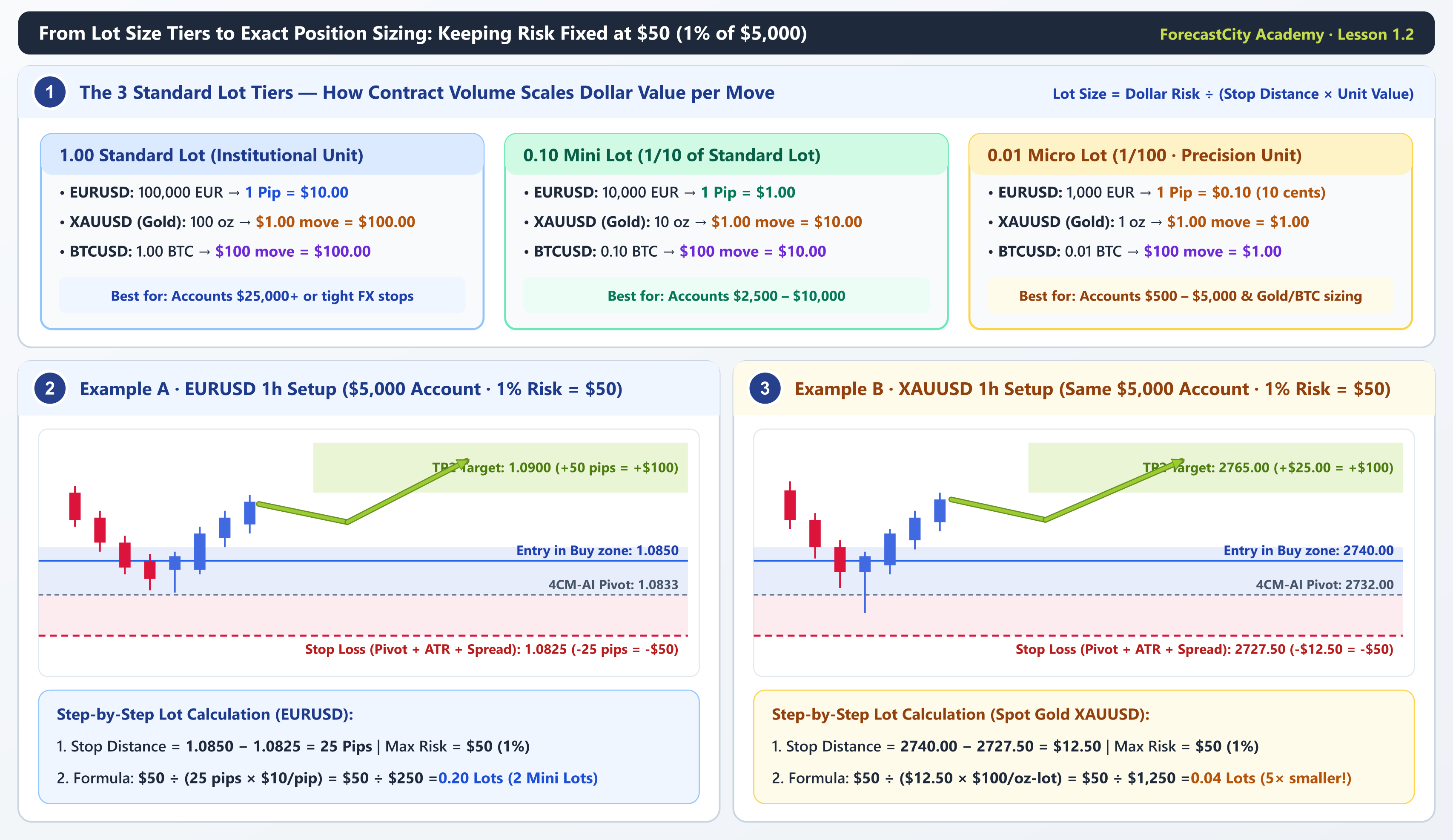
- Contract Size Hierarchy (Standard, Mini, Micro): Reducing your lot size from
1.00to0.10to0.01scales down the dollar value of every pip or dollar move by a factor of10and100. - The 3-Step Position-Sizing Formula: Divide your fixed Dollar Risk Budget by the product of your Stop Loss Distance and the Dollar Value per Unit on 1.00 Lot:
Lot Size = Risk ($) ÷ (Stop Distance × Unit Value per 1.00 Lot). - Equalized $100 Risk Across 3 Markets: Whether your setup is a
25-pipstop onEUR/USD(0.40lot), a$20stop onXAU/USDGold (0.05lot), or a100-pointstop onNAS100(1.00lot at$1/pt), your account loses the exact same-$100.00if the stop loss is hit.
Five worked examples you can use today
Suppose your account balance is $5000 and your rule is to risk exactly 1% ($50.00) per trade. Let's calculate the exact lot size across five different symbols:
- Example 1: EUR/USD (4-Decimal Forex): You enter inside a
4CM-AIBuy zone at1.0850with your buffered Stop Loss at1.0825.- Stop Distance =
1.0850 − 1.0825 = 0.0025 = 25 pips. - Value per pip on
1.00lot =$10.00. So a25-pip stop on1.00lot would lose25 × $10 = $250. - Exact Lot Size =
$50 ÷ $250 = 0.20 lots(2 Mini Lots, worth$2.00/pip × 25 pips = $50.00).
- Stop Distance =
- Example 2: USD/JPY (2-Decimal Yen Pair): You sell
USD/JPYat150.00with a Stop Loss at150.30.- Stop Distance =
150.30 − 150.00 = 0.30 = 30 pips. - Value per pip on
1.00lot at150.00=1000 JPY ÷ 150 = $6.67/pip. So30pips on1.00lot equals30 × $6.67 = $200. - Exact Lot Size =
$50 ÷ $200 = 0.25 lots.
- Stop Distance =
- Example 3: XAU/USD (Spot Gold, 100 oz per 1.00 lot): You buy Gold at
$2650.00with a Stop Loss at$2625.00.- Stop Distance =
$2650.00 − $2625.00 = $25.00per ounce. - Since
1.00lot holds100ounces, each$1.00move equals$100(and on0.01micro lot, each$1.00move equals$1.00). - A
$25.00stop on1.00lot would lose$25 × $100 = $2500. - Exact Lot Size =
$50 ÷ $2500 = 0.02 lots(2 Micro Lots =2ounces of Gold ×$25stop =$50.00risk).
- Stop Distance =
- Example 4: NAS100 (US Tech 100 CFD, $1/point per 1.00 lot): You buy a pullback at
20400with a Stop Loss at20300.- Stop Distance =
20400 − 20300 = 100 Index Points. - At
$1.00per point per1.00lot, a100-point stop on1.00lot risks$100.00. - Exact Lot Size =
$50 ÷ $100 = 0.50 lots.
- Stop Distance =
- Example 5: BTC/USD (Bitcoin, 1 BTC per 1.00 lot): You buy a breakout at
$68000with a Stop Loss at$66750.- Stop Distance =
$68000 − $66750 = $1250per Bitcoin. - Since
1.00lot =1 BTC, a$1250move on1.00lot equals$1250(and on0.01lot =$12.50). - Exact Lot Size =
$50 ÷ $1250 = 0.04 lots(0.04 BTC × $1250 = $50.00risk).
- Stop Distance =
Next up in Lesson 1.3: Bid, Ask, Spread, Slippage, Swap, and Crypto Funding Rate, we look inside the live order book to see why Short trades stop out before the candle touches your line and how to protect your trades from rollover and overnight fees.