
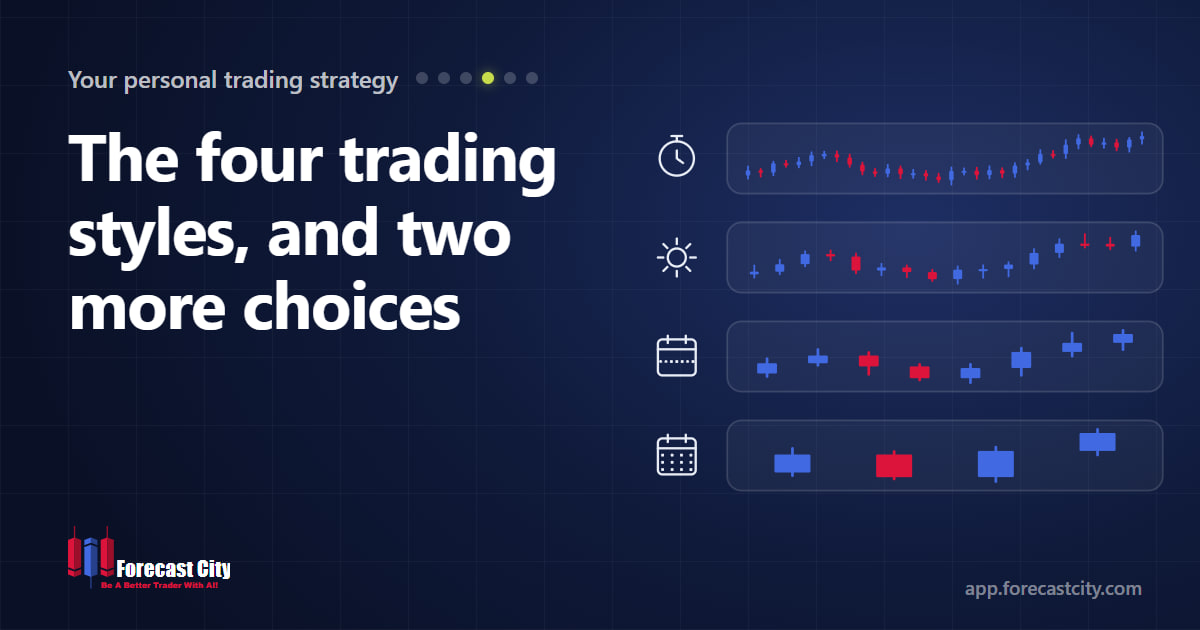
A trading style is defined by one simple question: how long do you hold each trade? That one choice decides your timeframe, your daily time and the kind of pressure you feel. In this lesson you will see what each style asks of you, so you can tell which one fits your day.
A style is different from a strategy. The style says how often you trade and how long you hold each trade. The strategy is your set of entry and exit rules.
| Style | How long a trade is held | Common timeframes | Time needed | Who it suits | Main challenge |
|---|---|---|---|---|---|
| Scalper | A few seconds to a few minutes | 1m and 5m | Hours of full, unbroken focus | Someone who decides quickly and stays calm under pressure | High trading costs and mental fatigue |
| Day trader | A few minutes to a few hours, all closed before the day ends | 5m to 1h | A few unbroken hours during the market's busiest hours | Someone who likes a daily routine and does not want an open trade overnight | The temptation to trade too much |
| Swing trader | A few days to a few weeks | 4h and D | One short check a day | Someone who is patient and also has another full-time job | Sitting through an open trade, and price jumps after the market reopens |
| Position trader | A few weeks to a few months, sometimes longer | D, W and M | One check a week | Someone with a long-term view and an interest in the wider economy | Sitting through big moves against the trade, and long patience |
A scalper loves excitement and quick decisions. If nothing happens on the chart for five minutes, a scalper gets bored. Each trade makes a small profit, so trading costs and one big loss can wipe out dozens of small profits.
A day trader likes order and balance. A day trader opens and closes trades during the day and goes to sleep without an open trade.
A swing trader is patient. A swing trader is willing to wait from a few days to a few weeks for one complete move. This style usually fits alongside a full-time job.
A position trader has a broad, long-term view. A position trader ignores the daily swings and focuses on the big trends.
Two more choices besides the time horizon
Rules or judgement?
Some traders feel calmer with precise rules written in advance. They turn every condition into a number and enter only when all the conditions are met.
Others make better decisions by reading the market's behaviour and drawing on their own experience. Both groups include successful traders.
Mark Fenton-O'Creevy and his colleagues studied traders at four investment banks in London. The more successful and the less successful traders differed in how they worked with their intuition.
Another of their findings matters too. Traders who managed their emotions before those emotions took hold did better than traders who fought an emotion only after it appeared. Writing your rules down before a trade is one of the simplest ways to manage emotions in advance.
If you trade on judgement, you still need a few fixed rules: one for the stop loss and one for the position size. Intuition helps you choose the entry, and the rules prevent the big loss.
Technical, fundamental or both?
Technical analysis focuses on price behaviour and the chart. Fundamental analysis focuses on the economy, the news and the value of the asset. After years of trial and error, Darvas built a mix of both.
If you enjoy reading news and economic reports, a fundamental or mixed method will probably feel more natural to you. If only the chart excites you, technical analysis is your place.