
Capital preservation is the foundation of the Trend Hunter Strategy. You eliminate risk early in the move by moving your stop loss to the entry price (Break-Even), and you use a daily candle-close stop rule (Soft Stop Loss) so random intraday spikes cannot knock you out of a valid setup.
No-loss guarantee: moving stop loss to Break-Even?
As soon as a trade moves enough in your favor, you move the stop loss of all remaining open orders to the entry price (Break-Even). Once your stop sits at Break-Even, a market reversal closes your remaining orders at zero and your capital suffers no loss.
Because take-profit targets sit at support and resistance levels that can trigger a pullback, the standard time to move stops to the entry price is when price hits TP1, TP2, or TP3.
If TP1 sits very close to your entry price or the chart setup strongly favors higher targets, wait until price reaches TP2 or TP3 before moving stops to Break-Even. Waiting avoids getting closed out early by a normal minor pullback.
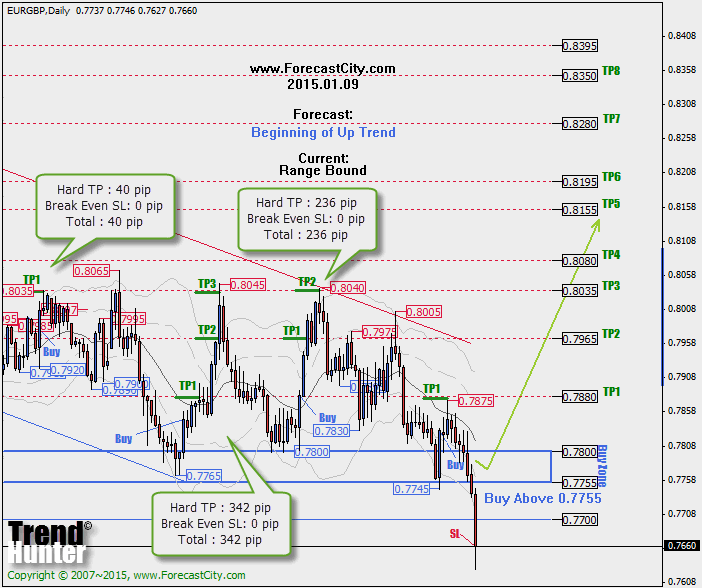
Break-Even examples on EURGBP daily (Figure 1): On 2014-08-08 (first Buy), after price hit TP1 for 40 pips, stops moved to the entry price and a pullback closed the rest at zero. On 2014-10-02 (second Buy), after banking 324 pips across TP1, TP2, and TP3, a pullback closed the rest at entry. On 2014-11-12 (third Buy), price banked 236 pips on TP1 and TP2 before reversing to close the remaining orders with zero loss.
Using daily WEMA-21 to time Break-Even?
The daily WEMA-21 moving average gives you a second precise rule for timing Break-Even. On the daily (D) chart, price rarely crosses WEMA-21 without reacting to it.
If WEMA-21 sits beyond your take-profit targets or far from your entry price, no immediate barrier threatens your setup. If WEMA-21 sits close to your entry price, apply one of two rules based on the DTO pattern strength:
Strong DTO entry pattern: Move the stop loss to the entry price after price crosses
WEMA-21by one 264-day Average True Range (1 × ATR(264)).Weak DTO entry pattern: Move the stop loss to the entry price as soon as price touches the
WEMA-21line.
Accepting a loss when a daily candle breaks the entry zone
Occasionally, price breaks through the outer edge of the Buy zone or Sell zone before your stop loss has moved to Break-Even. When a valid daily break occurs, you accept the small planned loss and close your orders. However, if the daily pivot line sits beyond the entry zone, you can also keep your trades open until that pivot line is broken.
A break of the entry zone is valid only when a full daily candle closes outside the outer edge of the zone, at least 80% of the candle body sits outside the zone, and the candle is a healthy candle.
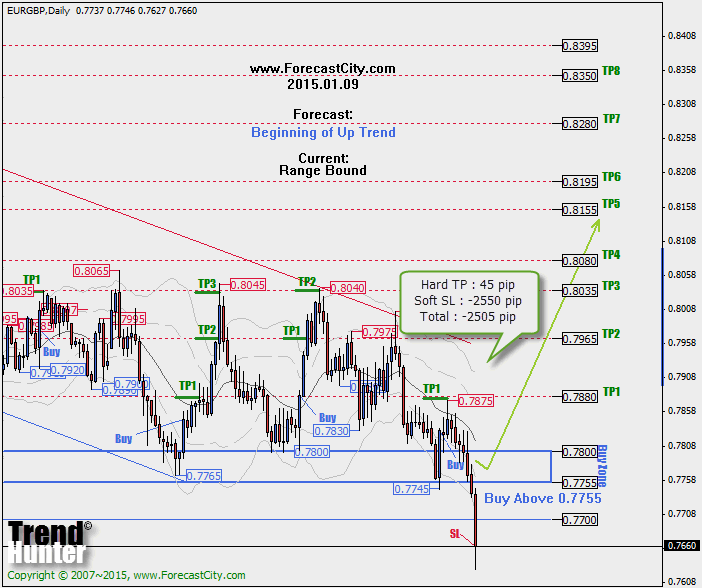
In Figure 2 on EURGBP daily, Buy orders opened on 2015-01-02 and banked 45 pips on TP1 before pulling back. On 2015-01-15, a healthy bearish daily candle closed below the Buy zone, triggering our exit on the remaining orders.
Why long-term daily setups use a Soft Stop Loss?
In trading, there are two types of stop loss:
Fixed or point stop loss (
Hard Stop Loss): You set a specific price level inside your trading platform so the broker closes the trade automatically the moment price touches that point.Soft stop loss (
Soft Stop Loss): Instead of registering a fixed price point in the platform, you use an exit strategy based on a confirmed candle close.
Using a Soft Stop Loss offers a major advantage in long-term daily trading. Often, even when price is about to reject from a support or resistance area (Buy zone or Sell zone), it first tries to pierce the zone with a shadow, creating a false breakout (False Breakout or Fakeout) before returning inside the entry zone. Placing a Hard Stop Loss in the platform can therefore knock you out with an unnecessary loss on a temporary shadow.
With an exit strategy (Soft Stop Loss), you exit only when you are sure a genuine break has occurred. Because in the Trend Hunter Strategy you check open trades once a day until your stop loss moves to Break-Even, if you see a strong break where a healthy daily candle has closed outside the zone, you close the trades manually at a loss.
To estimate your maximum potential loss before entering a trade, simply add the average daily candle body length over the past year to the outer edge of the entry zone.