
In the Trend Hunter Strategy, every setup splits into stepped take-profit orders (Hard TP) and one untargeted runner order (the Free Trade). This two-part exit structure locks in profits at each barrier while keeping you in the wave and growing your open profit if the trend runs for months.
Why most traders exit winning trends too early?
A strong trend is a trader's greatest asset, yet untrained traders almost always exit winning trends far too early with a small profit. Fear that the market will reverse and take back their open gain makes them close the trade right at the start of a multi-month move.
Spotting the exact end of a trend is just as hard as spotting its start. The Trend Hunter Strategy solves this problem with two complementary profit-taking methods that require no daily chart analysis.
Method 1: stepped profit-taking (Hard Take Profit and Scale-Out)?
Stepped profit-taking is built on probability laws and trend lifetime. As a trend grows older, the probability that it will stall and reverse increases. In addition, trends usually end when price runs into a major support or resistance barrier.
Every weekly forecast maps in advance the support and resistance barriers that lie along the path of the future trend (TP1, TP2, ...). Because the Trend Hunter Strategy is designed to capture large long-term waves, we set on average around 10 take-profit targets along the path of the wave. In money management, entering at one point and gradually closing portions of your position at levels where reversal probability rises (such as support and resistance barriers) to progressively reduce your capital at risk is called Scale-Out.
Because MetaTrader does not allow several take-profit levels on a single ticket, you open several equal-sized orders at the same entry price, each set to one fixed target (Hard Take Profit). In AI Strategy Studio, you can also configure multi-target partial exits directly on the chart.
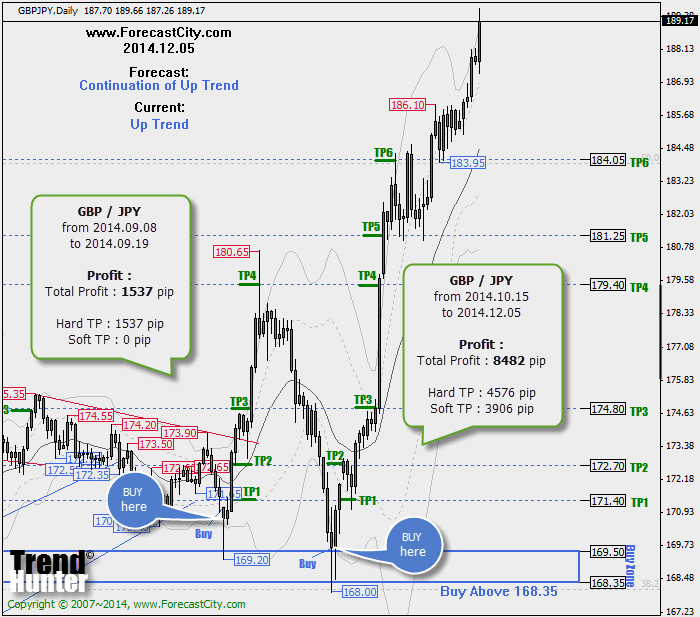
Stepped profit-taking on GBPJPY daily (Figure 1): On 2014-09-08 (first Hammer Buy setup: 7 Hard TP orders and 1 Free Trade), four orders hit their targets for 1537 pips in 8 trading days before price pulled back and closed the rest at entry. On 2014-10-15 (second Hammer Buy setup), six orders hit their targets by 2014-11-06 for 4576 pips in 15 trading days, while the 7th and 8th orders held 3906 pips of open profit by 2014-12-05.
Method 2: the Free Trade (Free Take Profit)?
Alongside your stepped targets, always leave one order open with no fixed take-profit target (Free Take Profit). The final fixed target sits at a heavy support or resistance barrier where most trends stop. Even so, powerful macro trends sometimes smash right through that final barrier and run for thousands of extra pips.
Keeping one untargeted Free Trade open ensures you never miss an extended wave. When a weekly forecast later announces the end of the trend, you close the Free Trade manually (Soft Take Profit).
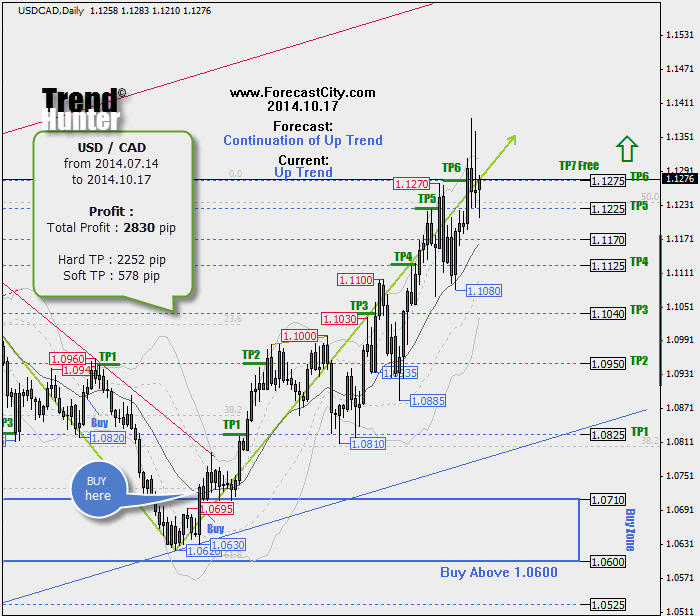
On USDCAD daily (Figure 2), after a daily Valley formed on 2014-07-14, we opened 6 targeted Buy orders and 1 Free Trade. All six targeted orders closed at their targets for 2252 pips by 2014-10-17, while the 7th order (the Free Trade) stayed open.
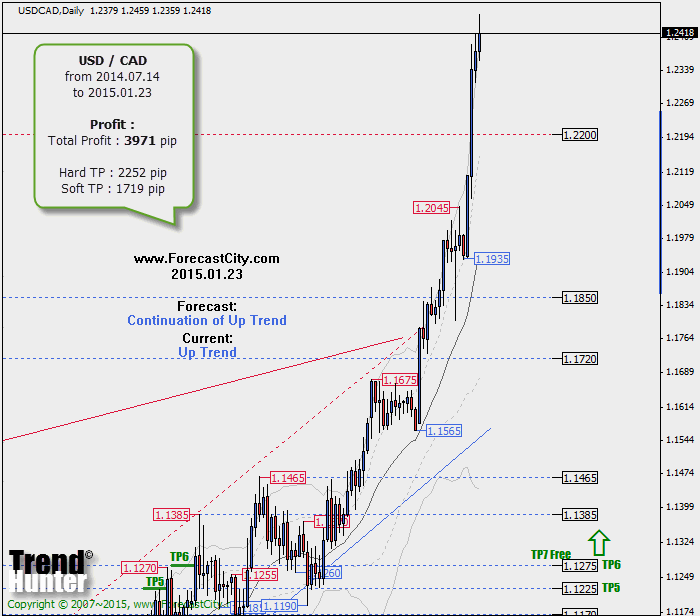
In Figure 3, holding that single untargeted Free Trade open until 2015-01-23 produced 1719 pips of profit on its own.
Four advantages of combining stepped targets with a Free Trade
Clear daily targets: Support and resistance barriers are mapped in advance on the daily chart, so you only watch for the end of the trend.
Hands-off execution: Once your fixed targets are set and your stop loss moves to Break-Even, you do nothing for weeks or months while profits bank automatically.
Minimal time commitment: Checking the chart once a week is enough.
Calm weekend decisions: You review open positions on Saturday or Sunday when Weekly Forecasts are updated while the market is closed.