
Few topics in trading are surrounded by more confusion than Leverage. Many beginners believe that switching an account's leverage from 1:100 to 1:500 automatically multiplies the dollar loss of every pip by five: while others use high leverage to open giant lot sizes until their broker suddenly force-closes their trades in a Stop-Out. In this lesson, you will see step-by-step mathematical proof of what Leverage, Used Margin, Equity, Free Margin, and Margin Level (%) actually do, and how to make your account mathematically immune to Margin Calls and Stop-Outs.
Everyday analogy: the refundable security deposit: Imagine renting a $10850 car for a business trip. Agency A asks for a $108.50 refundable security deposit on your credit card (1:100 leverage), while Agency B asks for only a $21.70 deposit (1:500 leverage). If you scratch the bumper and the repair bill is $20.00, does Agency B charge you five times more? Of course not: both charge you the exact same $20.00. In trading, Used Margin is simply that temporary refundable security deposit, and Leverage only decides how much deposit is locked while the trade is open.
Step 1: 1:100 vs. 1:500 Leverage: the side-by-side mathematical proof
Suppose two traders: Trader A and Trader B: each deposit $1000.00 into their broker accounts:
- Trader A selects 1:100 leverage (meaning the broker requires
1/100or1.0%of a contract's value as refundable Used Margin). - Trader B selects 1:500 leverage (meaning the broker requires
1/500or0.2%of a contract's value as refundable Used Margin).
Both traders spot the exact same setup inside a 4CastMachine AI Buy zone on EUR/USD at 1.0850, place a 20-pip Stop Loss at 1.0830, and open the exact same position size of 0.10 Mini Lot (10000 Euros, worth $10850 notional value, where 1 pip = $1.00). Let's compare their accounts number by number:
- Used Margin (Locked Collateral):
- Formula:
Used Margin = Notional Contract Value ÷ Leverage. - Trader A (
1:100):$10850 ÷ 100 = $108.50locked as Used Margin. - Trader B (
1:500):$10850 ÷ 500 = $21.70locked as Used Margin.
- Formula:
- Free Margin (Remaining Cushion at Entry):
- Trader A (
1:100):$1000.00 − $108.50 = $891.50of Free Margin. - Trader B (
1:500):$1000.00 − $21.70 = $978.30of Free Margin.
- Trader A (
- Dollar Loss if the 20-Pip Stop Loss is Hit:
- On a
0.10mini lot ofEUR/USD, every pip is worth $1.00 regardless of account leverage. - Trader A loses:
20 pips × $1.00/pip = -$20.00 (-2.0% of account). - Trader B loses:
20 pips × $1.00/pip = -$20.00 (-2.0% of account).
- On a
When the trade closes, each broker unlocks the Used Margin deposit ($108.50 for Trader A and $21.70 for Trader B), and both accounts end up with the exact same $980.00 balance.
Golden Law of Leverage: Changing your account leverage does NOT change the dollar value of a pip or your dollar risk on a given lot size. Only Lot Size × Stop Loss Distance determines how many dollars you risk. High leverage only becomes dangerous when an undisciplined trader uses the extra Free Margin to open 2.00 lots instead of 0.10 lot.
Step 2: The 5 account metrics in your trading terminal
At the bottom of MetaTrader, cTrader, and ForecastCity's Virtual account panel, you see five live numbers. Look at the three panels in the diagram below to see how those five numbers interact and how a broker Stop-Out works:
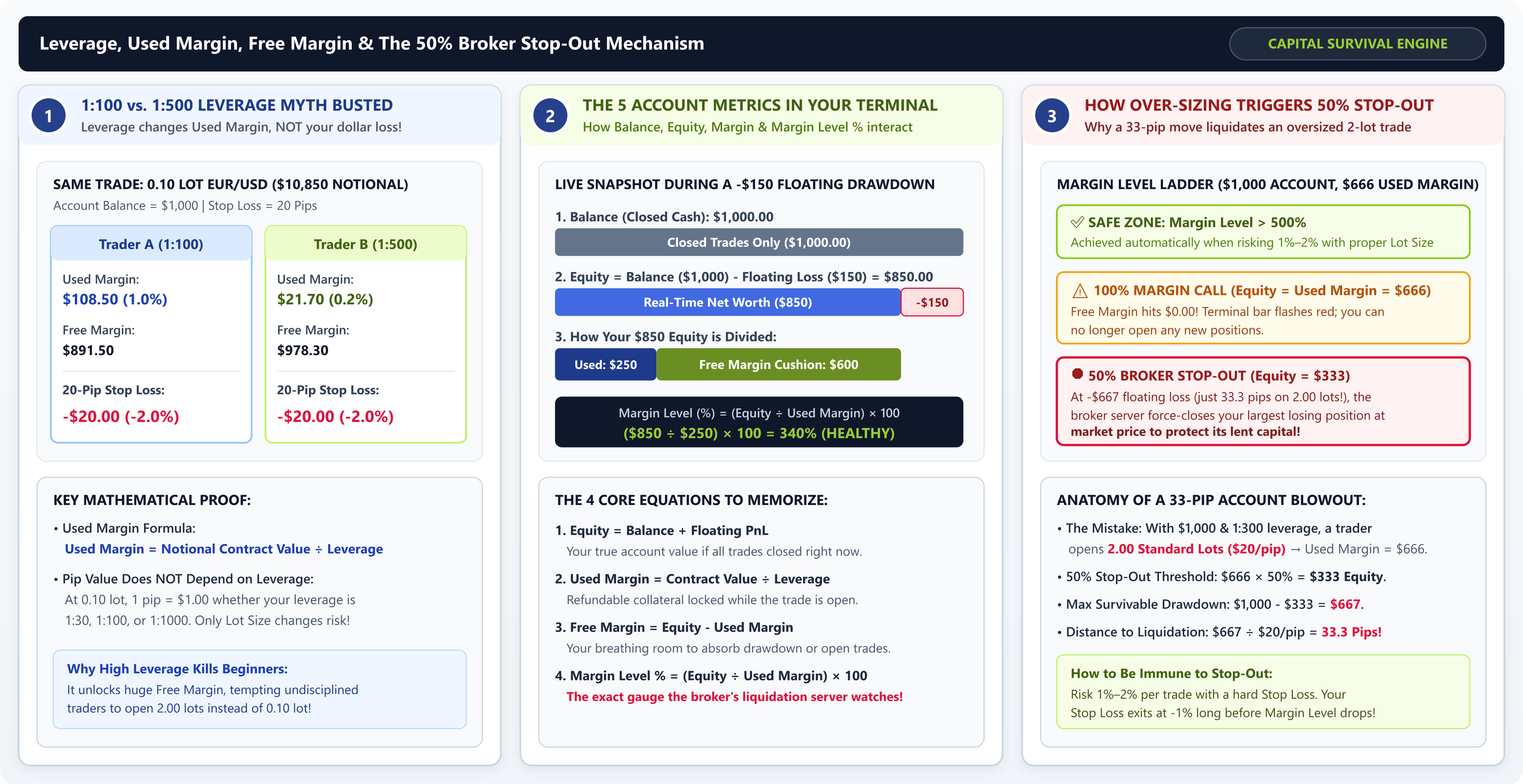
- 1:100 vs. 1:500 Leverage Proof (Panel 1): On the exact same
0.10lotEUR/USDtrade with a20-pipstop,1:500leverage reduces your locked Used Margin from$108.50down to$21.70, while your20-pipstop loss risk stays identical at-$20.00(-2.0%). - The 5 Live Account Metrics (Panel 2):
- Balance: Your cash from closed trades only (e.g.,
$1000.00). It does not move while a trade is open. - Equity (
Balance + Floating PnL): Your real-time net worth if all open trades closed right now. If your open trades are at-$150.00, your Equity is$1000 − $150 = $850.00. - Used Margin: The refundable deposit locked by open positions (e.g.,
$250.00). - Free Margin (
Equity − Used Margin): Your available breathing room to absorb drawdown or open new trades ($850 − $250 = $600.00). - Margin Level % (
(Equity ÷ Used Margin) × 100): The health gauge of your account. Here,($850 ÷ $250) × 100 = 340%.
- Balance: Your cash from closed trades only (e.g.,
- Margin Call (100%) & Broker Stop-Out (50%) (Panel 3): When floating losses drain your Free Margin to
$0.00, Equity equals Used Margin and Margin Level hits 100% (Margin Call): you can no longer open new trades. If losses continue until Margin Level drops to the broker's Stop-Out threshold (typically 50%), whereEquity = 50% of Used Margin, the broker server automatically liquidates your largest losing position at market price.
Step 3: Anatomy of a 33-pip Stop-Out disaster (worked calculation)
Let's trace with exact numbers how an undisciplined trader blows up a $1000 account on a tiny 33-pip move by abusing leverage:
- The Over-Sized Entry: A trader has
$1000balance with1:300leverage and opens 2.00 Standard Lots onEUR/USD($200000contract value, where every single pip equals $20.00.) without a Stop Loss. - Used Margin Locked:
$200000 ÷ 300 = $666.67locked as Used Margin. That leaves only$1000 − $666.67 = $333.33of Free Margin. - 100% Margin Call after just 16.6 Pips: As soon as
EUR/USDdips16.67 pipsagainst the trader (16.67 × $20/pip = -$333.33loss), Equity falls to$666.67, Free Margin hits$0.00, and Margin Level hits100%. - 50% Stop-Out Liquidation after 33.3 Pips: If the broker's Stop-Out level is
50%, liquidation triggers the instant Equity drops to50%of Used Margin:$666.67 × 0.50 = $333.33. That means a floating loss of$1000 − $333.33 = -$666.67(just$666.67 ÷ $20/pip = 33.3 pips: less than half of a normal day's range.) forces the broker to liquidate the position and wipe out two-thirds of the account.
How to make your account 100% immune to Stop-Out: When you follow the Grade 1 position-sizing rule: risking 1% to 2% per trade with a hard technical Stop Loss: a 0.10 lot trade on a $1000 account uses only $21.70 to $108.50 of margin (a Margin Level of 900% to 4600%), and your Stop Loss closes the trade at $980 Equity long before Margin Level ever approaches 100%.
Now that you master order types, lot sizing, and margin math, move to the final lesson of Grade 1, Lesson 1.6: Trading Sessions and High-Volume Killzones Across the 4 Markets, to learn the exact hours of the day when institutional liquidity drives clean, high-probability trends.